I didn’t expect reading this book can turn into a reflection about myself, but friction often reveals more than comfort ever could. I didn't even want to talk about this book at the start.
This book made me uncomfortable in a way I didn’t expect. It felt like race was emphasized more than necessary, almost as if it was trying too hard. The lack of subtlety made it difficult for me to stay immersed in the story.
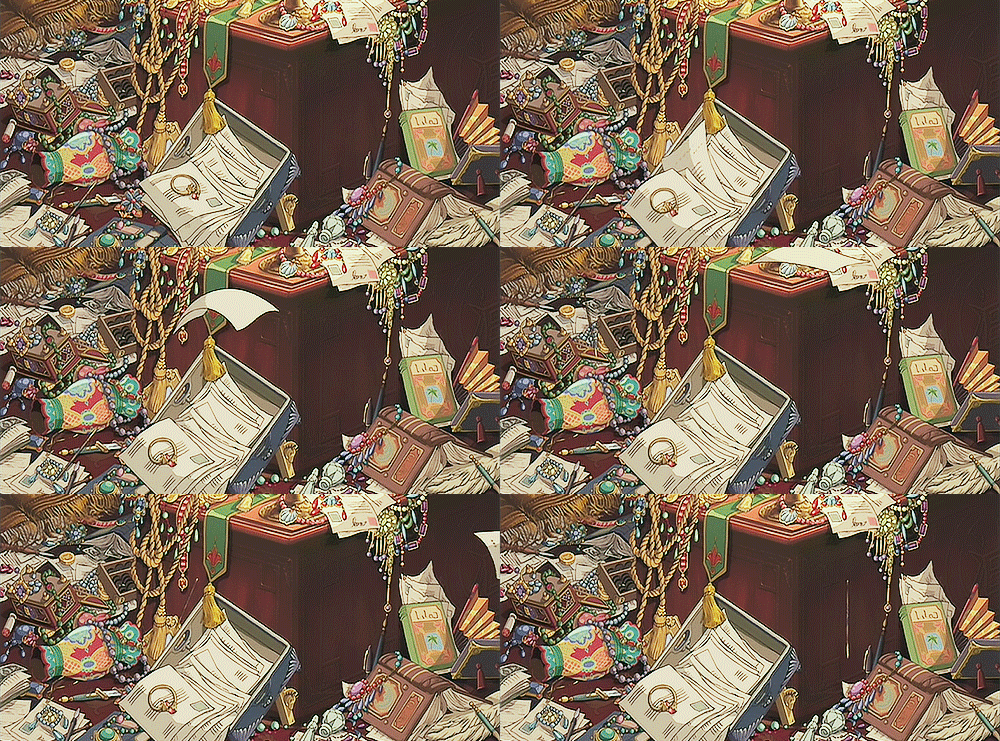
I also struggled with the excessive listing. There were too many details that didn’t feel essential to the core narrative. As I’ve mentioned before in this blog, I’m not good at processing information that feels unimportant to my brain. It becomes noise, and that noise distracted me from the emotional arc. That discomfort led to an interesting realization about my cognitive preferences. I’ve mentioned “noise” several times throughout this blog. Some writers use specificity as texture and listing as immersion. It is an intentional stylistic choice. For some readers, it works but for me, it doesn’t. It comes down to cognitive preference, so there is no right or wrong here.
I have almost zero tolerance for narrative noise. This explains why I dislike filler episodes and get bored with excessive details, especially names and numbers. With a designer’s brain, I appreciate clean, curated work. I value negative space. My brain prefer only what is necessary to move the story forward.
While I admire the richness and detail in Orhan Pamuk’s and Carlos Ruiz Zafón’s writing, I am also in awe of writers like Haruki Murakami or Kyung Sook Shin, who can express complex, weighty emotions with remarkable simplicity. Pamuk and Zafón create immersion through accumulation. Murakami and Sook Shin create depth through subtraction. On the surface, it looks simple, but we know it is not. Anyone can pile details but not everyone can remove them and still leave resonance.
Maybe that is the contradiction I live with. I admire maximalism, but I move through the world as a minimalist. I respect the cathedral, but I build a quiet empty room for myself. And sometimes, a book is less about whether I love it or not, and more about self-discovery, observing our own thinking, about noticing the small frictions that reveal us to ourselves.
So every friction matters, take note on every annoyance, there's a lesson there.
The book I'm referring to is Tomorrow, and Tomorrow, and Tomorrow by Gabrielle Zevin.
Note: I just finished the last few chapters in one sitting yesterday while waiting for berbuka. It broke me a little, until it came to the chapter in the game (it felt like a filler episode), it could be done much better. But let's not spiral into that.
I stand by my point, it could be better without the excessive listing. But that was just me.

Post Comment
Post a Comment