Image Slider

Showing posts with label haruki murakami. Show all posts

Books : Re-reading Books and Guilty Spending

September 19, 2016

I chose to bring Haruki Murakami's : What I Talk About when I Talk About Running for my previous trip to Indonesia. I think it's my third time to re-read the book. It was a great choice, seeing that I went to Bromo for my 10km trail run. It feel like it might get me all motivated and inspired before the run.

I actually finished the book after the run - the second last day, so the Haruki's fire didn't help me much during my worst 10km trail run that weekend :D But reading his DIY marathon in Athen-Marathon is inspiring, the training for his Ultramarathon is inspiring, the fact that he runs almost every single day for more than 30 years is inspiring. So I should definitely re-read the book every year, to keep me going strong. ♥ 

*

There is an old caucasian lady at my office selling books and novels near my office every Thursday. She opens her booth every week, and I try not to stop by every so often. Once I was searching for Neil Gaiman's : The Graveyard Boy - the one that was illustrated by Chris Riddell. I asked her, and she told me that she has several more of Neil's book at home that she will bring for me. I booked Orhan Pamuk's first book that was translated to English by Faber : The White Castle that I found as well.

So then I bought those 2 books and avoid stopping by at her small booth anymore. I'm really looking forward to buying Roald Dahl's books in the future. Here is an illustrations of my new books ! 


*

I also bought a 112-pages graphic novel : Soppy by Philippa Rice , found the single book in Borders, ioi City Mall :D It is a compilation of quirky comic + illustration inspired by her own real-life moments, living with her boyfriends. There are a lot of moments that I can relate to, since I'm living with my husband in a small one-room apartment, sharing spaces, silly arguments and all.

Note : You can buy this for your partner during your anniversary or valentines day. Looove.
True love isn’t always about the big romantic gestures. Sometimes it’s about sympathising with someone whose tea has gone cold, watching TV and sharing a quilt, or allowing your partner to order take-away pizza again. When two people move in together, it soon becomes apparent that the little things mean an awful lot. The throwaway moments in life become meaningful when you spend them in the company of someone you love. Soppy is Philippa Rice’s collection of comics based on real-life moments with her boyfriend. From grocery shopping to silly arguments and snuggling in front of the television, Soppy captures the universal experience of sharing a life together. - Philippa Rice
*


Last week I bought another 2 books ! This time, Haruki Murakami's : After Dark + After the Quake. I actually read these books several years back from a pirated e-book my friend shared with me. These 2 books are the thinnest books among all Haruki's books and they are both priced as expensive as all the other books : so I didn't buy them right-away. I read the pirated version in one-shot :D Guilty as charged.

But last week I saw that Borders was having a promotion on all Haruki's books : "Buy One Get the Second One for Half Price" and I took those two books without further thinking. Told Af that it's a present for myself la, to reimbursed my tax this year la, for finishing up my long awaited freelance work la, apa la. He didn't buy it. He knows I just buy books because I want to buy books - for no reasons. Ha.

Anyway, I'm currently re-reading After the Quake and almost finish it. 

*

And for the Game of Thrones : Book 1 - I finished it. I watched the series concurrently while I read the novel, and watching the series was much much faster than the reading itself. I can't keep up. I decided to not continue reading all the series and wait to watch the series instead. 


Book : Haruki (Wind) + George (a Game of Thrones) + Sailormoon

June 02, 2016

I relocated my mini book shelves into the living room again, I think it probably stayed in our bedroom for a month or two and I don't like the idea of letting them sit in the dark room without the sun for long. They will turn musty. For now, I only keep some books of the chosen authors : Haruki Murakami, Orhan Pamuk, Elif Shafak, Chuck Palahniuk, and Albert Camus, also some spiritual poetry books and quotes, plus almost all my graphic books and travelogues. It is so hard to leave all my books behind at Ma's - but this is what I manage to keep for now :


*

After finished rereading Wind by Haruki Murakami, I started on rereading his second novella : Pinball 1978. My main goal is to reread all Murakami's works in chronological order so I can imagine his world entirely based on how he created them all. Plus I'm waiting for his next book and praying hard that he will live long enough for me to read more of his books. My bookish nerd crush cannot end here. 


New to the addition, I bought George R.R. Martin's saga : A Game of Thrones in Kedah 2 weeks ago. I forgot to bring any books in the road-trip so as usual, I would buy a new one. This is a choice made to support my current fever in watching the series with Af *finally. Af has been watching the series for quite some time - I remember watching him watching the series when we first got married but I never really took any interest. The series was so 'orangey' and medieval. After a year, I finally became a fan :D

Af also suggested that we should watch the series from season 1 because I actually started 'really' watching the series in the middle of season 5. So I read the thick novel and watch the series from the beginning concurrently. I have something visual and moving to support my imagination and understand more about the details part of the story based on what's written by the original story-teller. This has been really fulfilling.  
*

Plus, I bought 2 more Sailormoon comics number 3 + 4 to add into my collection. I did searched for the remaining comics at my dad's house but couldn't find any. I wonder where they all went? We used to have a complete set.


Can wait to make a new little library in my own apartment, the books I currently have is way too many for the existing big book shelves in Azmi's room. I'll probably design one of the room with customized book cabinets to keep all the novels, and will take all my siblings' comics from our younger years' collection and probably adopt old magazines that still make sense. I'll have the whole room packed with books and when I die, if no one wants all the knowledge and the beauty in written words that I've been keeping - I would want them to be donated to school libraries and rumah kebajikan. So people can feel the joy that I had T^T

I managed to plastic wrapped all my new books while watching Breaking Bad season 4 :D

*

I also found Shaun Tan's latest graphic book : The Singing Bones, 2 days ago. The one with all his clay sculptures insipred by  75 short fairy-tales. I was in Kinokuniya, searching for graphic novel and I did found one of Lucy Knisley's graphic novel : An Age of License. I thought of buying that before I surprisingly found the Shaun Tan's book in the kids area. I left Lucy's comic and headed to the counter to pay for the oh-my-so expensive beautiful thick book. Things I would do for love =.=


*

Book : Pinball/Wind

August 16, 2015

As one of Murakami's big fan, I knew about his latest *but not so latest book that just came out. I went to MPH yesterday to check it out because the last time Tsukuru Tazaki came out, I got the book right-away at the same MPH. There were no long lines awaiting for the book like in Japan, I guess here in Malaysia, we aren't that craaaazy over him :D Thank God for that.

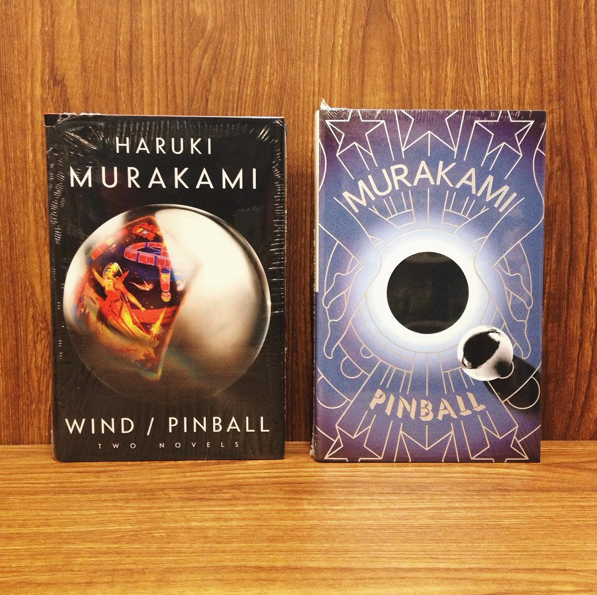
We went to the "Latest" book shelves and there I saw two reversible versions of Pinball/Wind :


*

I actually downloaded the e-books several months back and read it. There weren't any English version printed for these 2 books before this. These were the earliest Murakami's books written in 1979 & 1980, the first and second part of the Rat's series *if you are still following me. These 2 books are the most important books in the earliest part of Murakami's transition to being a full-time writer :D

The storyline weren't as strong and odd as others, but they are worth mentioning. I am still in love with them all :D I choose the right one even though all my other Murakami's books are from the left's ones version :( And it costed RM89.90 for a hard-cover ! If I waited for another 6 months, I'm pretty sure the paperback version will be released. 

But love does crazy things and I bought it nonetheless  ❤ 

PS : Oh, and they also published Murakami-san no tokoro, the printed and e-book version all in Japanese :( They aren't planning on translating everything to English. He answered to 3,716 questions that were asked to him from all those 37,465 questions *mine included. Now I really wish I can read Japanese :(

*

Book : 1995 Sarin Attack and Social Psychology

March 14, 2015

I haven't update write anything on books lately. Previous read : Murakami's latest story for The New Yorker 3 weeks ago, titled Kino and Thomas Harris's first book in the Hannibal Series : Red Dragon - both I read digitally on iBooks.

Current read :
  • Underground by H.Murakami *I spent my MPH coupon on this book and didn't regret it.
  • The Silence of the Lambs by Thomas Harris *second e-book from the Hannibal series
  • Midnight's Children by Salman Rushdie *I borrowed from Ivy

* 


Underground is a non-fiction, a compilation of interviews done by Murakami to Subway Sarin Attack's victims in Tokyo subway on March 20, 1995. Five members of the Aum Shinrikyo religious cult released sarin contained in a plastic bags in the Tokyo's subway train. 13 people died, hundreds of people severely affected and thousands more somewhat affected by the poisonous gas.

Sarin was originally invented during the WW2 by the German scientist. It is stated that Sarin is 20 times more powerful than cyanide. In the attack, the plastic bag contained with Sarin vaporized into the air in a gas form, everyone inhaled or touched it directly or indirectly were all affected.

Murukami tracked down hundreds of victims and interviewed some of the willing victims. Many victims turned down the offer to be interviewed because they rather forget the incident and some were still afraid of the Aum cult.

This happened around 20 years ago.

What hit me when I read the book : Those interviews make it real, all stories were told by the victims , it is connected like a huge invisible link that relates to so many big incidents in the world : the 9/11, the Holocaust, the Boston Marathon Bombing, the World War, etc. My purpose is to learn and understand, not to point fingers to who's responsible.


*

Things I found interesting about some Japanese people in the 90's based on the interview :
  • Normal salary-man (*that work 9am-5pm) took the subway to work. They took roughly around 1-2 hours to arrive to their office. They come in 1 - 2 hours earlier before they start working. We don't really do that here, we are always late. Office hour at 9am means we come in at 9.30am. *but hey I always come in around 8.50am.
  • Most people were aware of the existence of the cult. There were Aum school, Aum hospital, Aum research center. I found it odd, knowing how established they were. 
  • When the train conductor announced that there were a poisonous gas in the train and asked all passengers to leave the train, nobody panicked, nobody ran. Everyone walked out patiently like nothing happened *this is based on the interview. I found it hard to relate. How can they managed to be so calm in emergency situation? Were they really trained to be that calm or they thought the situation weren't as serious as it was?
  • There were many cases of post-traumatic stress disorder in those interviews. Mostly relatable, it's great to learn how people cope with traumatizing experience. 
  • I relate this incident with any other religious terrorism that happened in this world. 
  • Later in 2000, Aum removed Asahara as the leader and changed its name to 'Aleph', they also vowed to respect the government's law. 

*


At the same time as I was reading the book, I also took a course in Social Psychology by Wesleyan University. I managed to connect certain findings from all the lectures to the Sarin Attack incident :


  • Obedience to Authority : How the Aum followers chose to follow the order that had been assigned to them, even if they know how bad the effect would be. Why did they chose to do such an awful thing that cost other people's lives? How do some people choose to renounce their life and live a life decided by someone else? Is this a sign of weakness or total obsession? 
  • Countering Terrorism : It happened in Japan, it happened everywhere around the world. As a person, how would we react to this? What can we do to avoid future incidents? 
  • Bystander Effect : When a lot of victims passed out after they inhaled Sarin in the train, there were a lot of bystanders chose not to help. They stared, they ignored, they looked at each other. Only some people helped. In this situation, there were pro and cons. Pro : It would be dangerous for people that were not affected to touch or be near the victims because they might inhale the poisonous gas as well. Cons : Some people died because they were not helped or treated fast enough. Hundreds people were badly affected until now. So in this kind of situation, what should we do if we were the bystanders? 


PS : The lectures were given by Scott Plous, a professor of psychology at Wesleyan University. He managed to share a very interesting 7-weeks online course on social psychology with me. I highly recommend his class. The case studies, experiments and lesson were very useful and educative. The most important part is the lectures were not boring.

*

More read :
Interesting read on the Sarin attack, criminal psychology, influence of authority and study on religion/cult fanatics : Hist357

Book : Murakami San no Tokoro Website

January 17, 2015

If there is even a tiny chance for me to talk directly to one of my favorite author, Haruki Murakami, I'm going to make use of it. There's this project called : Murakami san no tokoro or (Mr. Murakami's place) started 2 days ago where people can write to him 1. asking him a question, 2. tell him something, 3. ask him his places or 4. talk about cats.  

He will accept submissions until this 31st January and will try to answer questions up the following 2 months. He will also read all emails and answer it himself. Although all in Japanese, I tried using Google Translate for the whole website to read some replies *not much can I get from direct translation, but oh well.

I wrote to him something personal, not expecting any reply - because it was not even a question, but it was something I want to tell him personally :D Never thought this chance would come. 

I received a generic reply to my email for the submission :


*

This feels ah-mazing 

Books : The Strange Library

January 03, 2015

*

Early present came from my person 
I actually begged him since we saw the book in the bookstore weeks ago. Never thought the latest Murakami came out so soon in Malaysia - *Dec 2014. Last year I bought the latest "Colourless Tsukuru Tazaki and his years of Pilgrimage" - the Japanese version actually came out in 2013 and it was being translated to English and later published afterwards in 2014. So for me, 2 books by the same author is like a double bonus - *even though I've never experience double bonus in my life - yet.

It is another one of his short story, not his famous lengthy fiction. But at least I can slow down my craving for his works for awhile. Take note : obsession. 


*

The book is quite pricey than other paperback due to all the graphics in it : I think it is more like a children story book than an adult fiction. And I only saw 2 versions - I personally prefer this version. This is the one that has been published by Harvill Secker. 

*


*

I don't see anything hipstery in reading Murakami, maybe it is widely known and overly talk-about these days, maybe he wrote things that are too deep to understand or too simple? I'm not sure how it came across one another - as one of the bookaholics, I stand to defend that reading books is far from seeing as someone cool or hipstery. Especially Murakami's. Book nerds and hipsters don't stand next to each other, so I think people should stop calling book nerds with another new label : I don't know what other bookaholics think, but I don't like it. 

I'm a book nerds, I breathe written words, I love authors, I spend money and time with books, I'm not cool or trying to be one. A down-right pure book nerd, not cool - period. 

*


 *

Review will be posted later after I ate it.
Thank you 

Movie : Tony Takitani

December 20, 2014

Tony Takitani is a short story by Haruki Murakami in Blind Willow, Sleeping Woman - a short story compilation. It's one of my favorites. Most of all his short stories are very light and almost easy to forget - but I couldn't forget this one.

The truth is, I still want something from Murakami after the last book I read written by him several weeks ago. So I googled his name with films. Other than Norweigian Wood which I avoid watching, I found out about Tony Takitani and The Second Bakery Attack for short filmed stories.

Weeks later, I got the copy and watched it.


*

It's a 75-minute short movie by Jun Ichikawa (2004). The soundtrack was composed entirely by Ryuichi Sakamoto. I can't forget some of the songs in the movie so I sometimes played the movie just to listen to the narration and background music. Just to fill my room with this song. T^T

Narrations and conversations are mostly short & simple, so most words are easy and familiar enough to my understanding. I love it. I loved it to the point that I kept thinking about it for several days later when I first watched it.

Something about the music makes my heart go numb. When I listen to the song, it feels like something cold and sad is creeping into my body slowly, picking my last happy memories and turning them into infinite silence. It makes me ask myself whether this silence is what I want to endure every day. This is a different kind of beauty. The one that undeniably touched your heart, but also the one that you try to avoid.

*


*

PS : 
I've always wanted my silence. 
But I don't want to be sad or lonely while having my solitude tho.
So, no Tony Takitani's life for me, please. 

Book : Hard-boiled Wonderland & End of the World

December 01, 2014

I finished reading the book last week - after a week. I finally found Murakami's book that I really like and would recommend if anyone wants to try any of his book *before this I found it hard to recommend his book because I was worried people won't like his odd writing, pace and mood. But this time, I really enjoyed the story. Almost all of his books are bringing different style : for example, 'Norwegian Wood', 'Sputnik Sweetheart', 'Colourless Life of Tsukuru Tazaki' are more like stories about life. While 'Kafka on the Shore' & 'the Wind-up Bird Chronicle' are a mixture of some unexplained oddity and life. 

'Hard-boiled Wonderland & End of the World' is a semi science-fiction/fantasy genre written in 1985.
Not quite sure how he got the idea of those parallel world of reality and subconsciousness. There was this one chapter that explained the scientific explanation on those theories - and that lost me. But other than that, I found the book really fun and worth my time reading.

I really like the part in the odd town where everyone is called with names like; The Gatekeeper, The Librarian, The Dreamreader, etc, people don't have shadows, and there are beasts that will die every winter and keep people's old dreams in its skull? Which would probably doesn't make any sense at all but it would, if all of those are written in metaphors. And if it does, than that is a stroke of geniuses. I still have too many books to read and don't have much time to reread it yet, and Murakami always said, "Just read, I don't write in metaphors!". Well, I don't believe him.  

This book deserves 4 stars with some cherry tomatoes on top.

*


*

And that, wrapped up all his books for this year.
It's sad to say that I finished all of his books, except 'After the Quake' - *which I won't buy, but find someone with the book, to borrow. This year has been my great reading year, because I found Murakami, and got the money to keep buying all of his books *chances to buy books has always been a privilege for me, because books can be quite expensive. I am really happy for this.


Currently I am reading David Mitchell's Cloud Atlas.

Books : The Rat Series from Murakami

November 15, 2014

It's been days since I started to think about which new book to read, after Jay Rubin's book. I wanted to read something that is not too thick and heavy ( both 'Hard-boiled Wonderland & the End of the World' and 'Ghostwritten' are quite heavy - it will take weeks to finish ). 

So I remembered the zipped folder a friend of mine sent to me early this year. It consisted of Murakami's e-books in .epub & .mobi formats, that can be read using ibook. I don't know what makes me think about it again early yesterday morning. I love physical books and I found reading on devices a nuisance, so I ignored those files all this time. 

But I decided to check it out again and I found precious 'Hear the Wind Sings (1979)' and 'Pinball ,1973 (1980)' in the folder. These 2 books aren't widely published in English, so you won't find it anywhere in the local bookstores. But the files were there in my Mac all this time! :F 

Both books are the earliest books that Murakami wrote when he was still a jazz-bar owner and not a full-time writer. I finished reading it this morning and will start the second one on Tuesday morning. The first book is mostly raw writing fiction, straight-forward Murakami's style, but even so, with a great deal of small random descriptions on his surrounding, which I like the most.

It's the first and second book before "A Wild Sheep Chase (1982)" & "Dance, Dance, Dance (1988) ", from the "Rat series". I found out about these books being a series before I started reading the third book, "A Wild Sheep Chase", when I read Jay Rubin's explanation about the Western publisher that didn't care to publish these series in a chronological order, so such thing like telling us it's a trilogy was simply ignored. But thankfully they still can do well as a stand-alone novel.


*

Books : The Music of Haruki's Words

November 13, 2014

I finished : 'Haruki Murakami & the Music of Words' by Jay Rubin.

I loved it. I never thought reading almost 400 pages of semi-autobiography / book discussions would be this entertaining. Jay Rubin, being one of his translator, a long friend and a self-confessed fan of Murakami wrote a thick book discussing almost all of Murakami's books & short stories, adding snippets of interviews, thoughts and comments from available published works both in English & Japanese. Thank God I used the MPH coupon to buy this book. 

Clearly this obsession is not getting near any ending.  

If you are interested in Murakami and his books, you should get a copy of this. But you need to make sure that you've read all of his books, because spoilers are scattered everywhere. Or you just have to skip some chapter based on the book title that you have not read yet.

This book is the closest to a semi-academic manuscript that I dream to write if I ever do a full academic research on a writer or novelist. Although he is an academician, Jay Rubin managed to write something that sounded straight-forwardly formal but in a fictional way of telling interesting story. An academician with a power to write story, well that is a very fascinating combination 


Book : Murakami's Style

October 20, 2014

Finished reading Dance, Dance, Dance by H.Murakami. 

I still hate all the unexplained things in all of his books. As a writer, I thought explaining odd things that happened in your book is your responsibility - because after all, the writer control everything in the fictional world that he created. But for Haruki, he feels much more comfortable leaving all those holes empty and unexplained. As he said that in the 'real world', a lot of things happen without us knowing why and no one can explain anything. So that's how he holds on to his stories. 

Well I hate it.  

Book : Sputnik Sweetheart

August 24, 2014

One of the thinnest Murakami's book I've read; Sputnik Sweetheart (229 pages), this took around 3 days of commuting to work. I bought it from Border's discounted book (*2nd book 50% off) with Dance, Dance, Dance - as the second book. Other than guiltily buying his latest "Colourless Tsukuru Tazaki and His Years of Pilgrimage", the hardcover version with free stickers to put on the cover even though I told myself that I'll wait for the paperback version. *failed*

In short, this is a story about a girl, Sumire, who wants to be a novelist, narrated by her best-friend K. She did everything in her life to be a writer but even though how good she was in writing, there was something missing in her work : a work that is just typically 'good' but not 'genius'.
And then she fell in love, with a woman 17 years her senior.

*

I love how it connects me to the love of writing, all the metaphors and narration. Simply put, it's another Haruki's work, and everything expected in his writing. Detachment, books, writing, silence thoughts, love, lost, confusion, missing part. Not sure how I can relate to the feelings with an older woman, but how he wrote it was by showing something as pure and innocent as how we fall in love, beyond anyone's control. So it wasn't that all weird and awkward much.

I noticed that I've read 6 of his books and countless short stories over the internet, written by him. None can I possibly recommend to people as something worth read except for "What We Talk About When I Talk About Running". But, what got me hooked with his writings at the first place were the way he writes things, the emotions he puts up in such simple words, and the dreamlike-odd-super-weird storylines. He's too fascinating to be ignored, so I can't stop.

I totally understand if people can't keep up with his works and I don't really recommend you to read them too :D


Some excerpts from the book :

*
"At this stage in your life I don't think you're going to write anything worthwhile, no matter how much time you put into your novels,' said Miu, calmly but firmly. "You've got the talent. I'm sure someday you'll be an extraordinary writer. I'm not saying this, I truly believe it. You have that natural ability with you. But now is not the time. The strength you need to open that door isn't quite there. Haven't you ever felt that way? "
*
"And it came to me then. That we were wonderful traveling companions, but in the end no more than lonely lumps of metal on their own separate orbits. From far off they look like beautiful shooting stars, but in reality they're nothing more than prisons, where each of us is locked up alone, going nowhere. When the orbits of these two satellites of ours happened to cross paths, we could be together. Maybe even open our hearts to each other. But that was only for the briefest moment. In the next instant we'd be in absolute solitude. Until we burned up and became nothing. "
*
We each have a special something we can get only at a special time of our life. Like a small flame. A careful, fortunate few cherish that flame, nurture it, hold it as a torch to light their way. But once that flame goes out, it's gone for ever. What I'd lost was not just her. I'd lost that precious flame. 
*
So that's how we live our lives. No matter how deep and fatal the loss, no matter how important the thing that's stolen from us - that's snatched right out of our hands - even if we are left completely changed people with only the outer layer of our skin from before, we continue to play out our lives this way, in silence. We draw ever nearer to our allotted span of time, bidding it farewell as it trails off behind. Repeating, often adroitly, the endless deeds of the everyday. leaving behind a feeling of immeasurable emptiness.

Books : March List

March 27, 2014

*


9. The Wind-up Bird Chronicle by Haruki Murakami

This reading took almost 3 weeks, longer than I intended. More than 600 pages long, with small text beautifully aligned near each other. My colleague asked me; "Is this your first Murakami's book?", I said it is my third. She said she will only read one book per author to know the writing style. I wanted to disagree but decided to only let this thought silently echoed in my mind : "You can't judge a writer by reading only one of his/her book."

If Zahir is about an obsession of finding a missing wife by Paulo Coelho. Then the Wind-up Bird Chronicle is an obsession about finding a missing wife by Haruki Murakami. They are almost alike in the theme and main focus but with a totally different lesson to be learned. 

With Haruki, it's always dream-like, ambiguous, seemingly lost in the character's thought, stories in stories, and most of it doesn't even make any sense at all. Sometimes I got short "hm" while reading, in the random odd chapter of one of the unimportant character's letter or childhood experience, imagine for the whole one chapter! The story doesn't even relate at all, except to vaguely explain certain behavior or is it?

I always wonder, what makes him write about random people in his own story? He makes all characters, even the one that crosses the road or work at the laundry have their own life in the story. He is that detailed to the bones.

*


10. What we talk about when we talk about running by Haruki Murakami

For anyone who wants to understand why some people love running so much, this book might give you a glimpse of what a long-distance runner feels about running. He wrote it to understand about his attachment with his routined life and while learning about himself in his running journal that he kept, he shared with the world about himself.

True, it isn't much. It is more or less like reading an informal journal. I learned about him, his routine, and his obsession. Anything to give me a glimpse of who he is as a real person in a real life, that is more than enough. I highly recommend this to people who love running, and writing.

*

11. Short Sufi Stories by Mohamad Yasin Owadally

This reading took less than 2 days on the train. A compilation of short stories for wisdom and guidance. The story that you heard when you were around 7-12 at sekolah agama. A light reading, I enjoyed putting yellow stickers on useful stories that I could use in the future. One of my favorite :

You've no idea how hard I've looked for a gift to bring You. Nothing seemed right. What's the point of bring gold to the gold mine, or water to the Ocean? Everything I came up with was like taking spices to the Orient. It's no good giving my heart and my soul because you already have these. So - I've brought you a mirror. Look at yourself and remember me. O love, O pure deep love, be here, be Now, be all; worlds dissolve into your stainless endless radiance. Frail living leaves, burn with you brighter than cold stars: Make me your servant, your breath, your core. 
Rumi says, "God is your mirror in which you contemplate yourself and you are His mirror in which He contemplates his divine attributes." 
Ibn Arabi says, "I won't serve God like a labourer in expectation of wages". 
- Love of Allah & Remembrance ( page 48 )

*


12. Langit Vanilla by Wani Ardy

I bought this book, among other books from independent poets.
I loved it ! I love how clean and neat her language is. The way writer writes things usually reflect how he/she thinks.

In my opinion, there is this trend of writing self-expresion in the form of so-called art. Even though art itself can be anything and everything, without any limitation. I strongly believe that art should be beautiful. Be it in words of poetry or story, or painting or photography. It should be beautiful. We might see things differently; some people think death is beautiful, some people don't. Some people use bad words in every breath and feels nothing, some people never even said the word "shit". So I guess we can't really put a real definition on that, huh?

To conclude this, I don't prefer to read any written books with obscene and vulgar language, even in a manner of speaking. Independent writing or not, just be aware of your language. We have enough dirts and rubbish in life.

Hati manusia itu sesuatu yang rumit, sulit. Sepuluh orang boleh melalui peristiwa yang sama, tapi belum tentu dua orang merasa perkara yang sama. - Pemuja Rahsia.
Kau manusia, kau tak boleh ada semua.  
*

Excerpt 03 : Solitude

March 16, 2014
“Solitude is, more or less, an inevitable circumstance. Sometimes, however, this sense of isolation, like acid spilling out of a bottle, can unconsciously eat away at a person’s heart and dissolve it. You could see it, too, as a kind of double-edged sword. It protects me, but at the same time steadily cuts away at me from the inside. I think in my own way I’m aware of this danger—probably through experience—and that’s why I’ve had to constantly keep my body in motion, in some cases pushing myself to the limit, in order to heal the loneliness I feel inside and to put it in perspective. Not so much as an intentional act, but as an instinctive reaction.” ― Haruki Murakami, What I Talk About When I Talk About Running.

Books : January List

January 28, 2014


1. Norwegian Wood by Haruki Murakami
I read IQ84 last year, took 2 months to finish reading the thick book. I am really curious about Asian Literature so I want to know more about these writings, Norwegian Wood was listed in my birthday wish list as well. I didn't regret my choice.

I love the direct and blunt type of language Haruki used in the book. It almost felt like reading haiku; speaking in short line of words, very simple. But feelings were sprouting everywhere in the book; be it loneliness, pain, detachment, love. What makes it impressive is how simple the writings are, carrying such heavy meaning.

Usually, if something is so simple, it's hard for us to notice the beauty. That was how I felt while reading it. I thought, 'this is too simple to be beautiful'. But he nailed it.

What I like about the book is the bluntness, and the depth of feelings in such simple writing. The storyline is straight-forward but a bit depressing : it's about suicide, first love, and detachment.

*


2. The Fault in Our Stars by John Green
I read this for several days while I was commuting. The book has large font sized text, which is not my favourite type of book, nice cover page and semi-formal language, not beautifully written, it feels like watching those chick-lit movies I stopped watching several years ago. I may not be one qualified reviewer but in my blog, I seldom take too much time sounding like the person I am not in reality, so this explains the semi-formal language as well. Yes, John Green wrote it like something that has been written in a blog.

My random thought : this is a book for pre-adult/teenage. This explains a LOT.

Storyline : Although I said I didn't quite like the book, I cried several times while I was reading it. These days, I can cry to every single thing, the hormonal imbalance makes me super sensitive over everything. It's annoying, to read in the train and try to control the tears.

The storyline is cliché, almost expected and no twist, just direct story.
I guess I won't be reading any John Green in the future.

Not to say it's not a good book, it's just not a 'great' book. I am more hard to please when it comes to books, I have my own 'standard'. And I love heavy and twisted stories. This was just too easy, it almost feels like I was wasting my time.

*
3. The Storyteller by Jodi Picoult
Good people are good people, religion has nothing to do with it.
Jodi Picoult is one of my favorite writer and I've read almost all her books. *17 books, to be exact. She loves to tell stories about relationship between human. Parents with children, husband with wife, between couples and friends, judge and murderer, lawyer and offender, doctor and patients, etc. It's always about relationship and conflict between that, not as simple as our lives are, but usually in ways that make me ponder and question a lot. Morally right or wrong, emotionally acceptable or not. Definitely not a chick-lit type of books.

This time, it's about the Holocaust, an ex-Nazi SS guard and one of the survivor's grand-daughter, a Jew. I love history and I love fiction, combining both is like having your favorite ice-cream topped with extra chocolate chips.

I was actually a bit disturbed, because reading books about genocide is a bit heart-wrenching, even if the book is fiction. The possibilities that it might be true, and can happen or happened. Phew. Not going to share any spoiler.

But this book is definitely a good one, highly recommended.
Thought-provoking, emotional, well-written story.

*

Excerpt 02 : Dance Dance Dance

January 17, 2014

“As time goes on, you’ll understand. What lasts, lasts; what doesn’t, doesn’t. Time solves most things. And what time can’t solve, you have to solve yourself. Is that too much to ask?” — from Dance Dance Dance by Haruki Murakami
Like Sofia Coppola, Haruki shows us how lonely he is from his works. The depth of his detachment from the social world is too visible, the energy and feelings he put in his works were touchable by reading his books. All the time I was reading, I kept on thinking "how he can put up with these kind of feelings and channel them into his works?".
His writing is a bit depressing, and I'm not going to recommend it to people as a 'must-read' books. But his works are phenomenal  indeed. It is understandable if the Westerners are impressed with Asian Literature only by reading Murakami's works. His ability to capture reader's feeling - phew.

He wrote beautiful things in the most simplest manner - almost blunt and direct, toneless but deep. His books that I've read : IQ84 and Norwegian Woods. 

Excerpt 01 : IQ84

December 07, 2013

You’re still young and healthy. Maybe that’s why you don’t understand what I am saying. Let me give you an example. Once you pass a certain age, life becomes nothing more than a process of continual loss. Things that are important to your life begin to slip out of your grasp, one after another, like a comb losing teeth. And the only things that come to take their place are worthless imitations. Your physical strength, your hopes, your dreams, your ideals, your convictions, all meaning, or, then again, the people you love: one by one, they fade away. Some announce their departure before they leave, while others just disappear all of a sudden without warning one day. And once you lose them you can never get them back. Your search for replacements never goes well. It’s all very painful—as painful as actually being cut with a knife. You will be turning thirty soon, Mr. Kawana, which means that, from now on, you will gradually enter that twilight portion of life—you will be getting older. You are probably beginning to grasp that painful sense that you are losing something, are you not? - Murakami , IQ84

Book : IQ84 *updates*

April 08, 2013

Notes :
Although I am a woman, I am not much of a normal-chick-lit & romance fiction's reader. Book reviews reading experiences mostly came from something as odd and heavy as this or as light and inspiring as Mitch Albom & Paulo Coelho. I know majority of this blog reader is pre-adult : below 24, due to my doodle interest. So I hope you won't take my book recommendation into your account, unless you are as bookaholic as me and read for life. Thank you 

*

Book 1 : IQ84

It has ended well, I took longer than I intended.
Maybe due to the very slow start.

It reminds me of The Girl with a Dragon Tattoo trilogy with less big words, odd names, political complications and wordily-visual brutal scenes. Both touch topics on publication and the dark horrifying side of rape cases. Aomame is a lot like Lisbeth Salander but without the super genius brain and photographic memory. If you loved Stieg Larsson's trilogy, most probably you'll love IQ84. You can read synopsis & reviews here.

This book is not suitable for young adult, because it is a little disturbing especially the terrifying scenes on child rape - at least it was disturbing enough for me. *Although Haruki Murakami did not visually written any of those scenes - the simplicity of his writing is quite impressive. Stieg Larsson was too visual and that was impressive in a different way. If you want something different than normal fictions, maybe you can try the book. 

Self-note : 
IQ84 is not IQ level - 84 but 1984, the year the event took place and Q stands for 'question'. 
One of the main character in the book, Tengo, reminds me of my colleague at the lab. Although he doesn't write books and teach at cram school.
I love his simple way of telling stories & emotions. Might read more of his books later.

*

Book 2 : IQ84

I can bear any pain as long as it has meaning. - IQ84
Along with the long story dragged slowly, I managed to keep on reading, sometimes for hours in the bus, and train, completely unaware of my surrounding. *which was pretty impressive. There were disturbing intense scenes : on Air Chrysalis and those creepy Little People from the book that Fuka-Eri wrote, on finally meeting the Leader, on purification part between Tengo &  Fuka-Eri? - I need a deeper understanding on why must intercourse has anything to do with self-purification , this reminded me so much of the Dan Brown's book - Da Vinci's Code. 

If Haruki chose not to explain it in the third book, well, he would be some-what a very irresponsible person. And I'll dislike him. He can't possibly dug a hole and leave it empty. A good writer needs to explain his story.

*

Currently on
Book 3 : IQ84


*

PS : Amazon bought the GoodReads ! 
Is that good? I hate Amazon, they are not Malaysia-friendly.

Inspiration : Haruki Murakami

November 21, 2012

Haruki Murakami's on Writing :

When I’m in writing mode for a novel, I get up at 4:00 am and work for five to six hours. In the afternoon, I run for 10km or swim for 1500m (or do both), then I read a bit and listen to some music. I go to bed at 9:00 pm. I keep to this routine every day without variation. 
The repetition itself becomes the important thing; it’s a form of mesmerism. I mesmerize myself to reach a deeper state of mind. But to hold to such repetition for so long — six months to a year — requires a good amount of mental and physical strength. 
In that sense, writing a long novel is like survival training. Physical strength is as necessary as artistic sensitivity.
*

Such discipline needs a very strong will.

You can read on other artist, writers and other interesting people on their daily routine , here.

*

Aiming for Haruki's IQ84 ,
hopefully I'll find it at BigBadWolf next month.